Showing posts with label theology. Show all posts

November 28, 2020

Faith Reconsidered

"Do you think you will go to the Christmas Eve service, or just pick up the stuff" read my mother's text.

"Pick up" I replied.

I had left some stuff at my mother's house the night before, and now needed to pick it up before returning to the Twin Cities, and meeting her at the Christmas Eve services was most convenient. But that was beside the point. I didn't want to go to church. Fortunately I had an excuse, other family engagements, but the thought of going to church was not attractive to me.

And that of course leads to the inevitable "why?" Why didn't I want to spend time gathered with others reflecting on the meaning of Christmas?

That I didn't know the people at my parent's church was part of it. Style was another. But the real reasons were deeper.

In past iterations of my faith, there would have been questions about commitment, sin, and things like that. Those questions still linger, but I am increasingly coming to own my identity in these in between spaces.

It is a strange thing to both deeply believe and deeply doubt. Again, in past iterations of my faith these things would have been cause for existential angst. They aren't now.

I am keenly aware of arguments for the existence of God that suggest she resides solely in the grey matter of our minds, filling up the spaces of the things we can't explain, and providing a variety of evolutionary advantages. For example, a commitment to something greater than ourselves which leads to altruistic activities that further the species at the expense of ourselves. Or the common notion that all paths lead to heaven; that there is one life source (or many) known by many different names in the various cultural contexts we humans share. (In particular, I appreciate the more nuanced versions of this thought, less focused on heaven and more focused on the nature of God.) I appreciate the internal logic of these arguments, and am aware of the conservative Christian arguments against them, which likely have corollaries in other religions. I agree with some of these traditional arguments.

What is changing now, is my willingness to side-step questions that allegedly demand an answer, and instead focus on being present, being a better person, and inviting Jesus Christ and those around me to be a part of that process.

I use the name Jesus Christ intentionally because I still believe. I was raised as a fundamentalist evangelical, and later attended the inter-denominational, but still evangelical, Fuller Theological Seminary, known for being too liberal for fundamentalists and too conservative for liberals. That was a needed and rewarding experience. Grappling with the nature of scripture and theology, who wrote the scriptures and how, and just as importantly, how the present versions of our Bible got to us. That experience cracked an iron curtain that was largely unwilling to dialogue with people and writings of other perspectives, other than to debunk them. Fuller didn't take that approach, and for that I am thankful.

For reasons both consistent and inconsistent with the Christian faith, I don't feel the need to convince people to become a Christian in the overt manner that I did as an extremely conservative Christian. I think there is a time and place for considering the why and the how of things, but it isn't my job to convince anyone of anything.

And I don't feel the need to gather on Christmas Eve, just because everyone else is doing it. I do think that gathering on Christmas Eve for any number of other reasons is a good idea. There have been years where that was exactly what I needed. For  many, it is one of the most meaningful parts of their holiday traditions, a quiet respite from an otherwise chaotic season. It's just that I would rather stand under the stars in the falling snow, with silence as my companion.

I may have my father to thank for this independence. When I was born, we didn't go to the kind of church other people went to, and we didn't have a pagan Christmas tree, just because others did. My father is not easily swayed by anything, least of all popular opinion. I respect that about him. Sure it can be maddening on some topics, but on balance it is a good thing.

He is also able to change his mind. 

Today, my father and I have Christmas trees in our front rooms. We both attend churches as normal and vanilla as can be. But thanks in part to my father, I question things, including my Christian faith. This in turn I think, does not diminish a divine connection, it enhances it, drawing me closer to our Creator, and the imago dei that we all share.

It is in that closeness, where it seems like heaven meets earth, in temples and on quiet snowy nights, that sometimes we change our mind. Sometimes for the better. 
June 01, 2014

Scripture on Judging Others

There is a tension in scripture on the use of the word "judge."

For example, John 7:24, and many other similar passages say things like, "Stop judging by mere appearances, but instead judge correctly.”
 

While in contrast, Romans 14:4 says, "Who are you to judge someone else’s servant? To their own master, servants stand or fall. And they will stand, for the Lord is able to make them stand... You, then, why do you judge your brother or sister? Or why do you treat them with contempt? For we will all stand before God’s judgment seat."

And yet, 1 Corinthians 6:2 says: "Do you not know that the Lord’s people will judge the world? And if you are to judge the world, are you not competent to judge trivial cases?"

This all seems like it could be a problem.  Taking a look at the full context of each of those passages helps, and I think the Apostle James offers further assistance. Judging rightly is closely related to teaching, admonishing, and loving others well, and James has this to say about teachers: "Not many of you should become teachers (which inevitably involves making judgements), because you know that we who teach will be judged more strictly. [Remember] we all stumble in many ways." James 3.

And Paul says this: "Do nothing out of selfish ambition or vain conceit. Rather, in humility value others above yourselves, not looking to your own interests but each of you to the interests of the others." Philippians 2:1-4


In my judgement, many Christians are like this blogger, who writes at length on why it is ok to judge others, without looking at the tension in scripture, or talking about how to do so well.  (He lists nearly every passage that says judge, but never looks at Romans 14.)

Exercising discernment, care, concern, teaching, or judgement without humility is an effort doomed to fail, and too often, that is exactly what happens. (For me in particular.)  That is one of the reasons non-Christians, and former Christians, and Christians who often don't identify as Christians, and our culture in general disdains judgement so much; they rarely experience it combined with humility and graciousness.

May 09, 2012

The Kingdom of God is the Gospel

I recently read an interesting article, Is the Mega Church the New Liberalism.  It focused on culture, gospel, megachurches and compromise with a focus on the issue of homosexuality.

As I'll summarize here, I don't think compromise on the issues of homosexuality or liberalism is the issue for the contemporary megachurch, rather the over-arching issue is American consumerism and individualism.  That in turn affects sexual identity, politics, and many other personal habits which may or may not be healthy.

My argument is that one reaches that conclusion by taking a close look at the Gospel of Jesus Christ, and frankly, how one defines the word gospel.

In Mark 1:15 Jesus says, “The time has come, The kingdom of God has come near. Repent and believe the good news!”

In this passage, the "good news" or gospel is directly tied to the Kingdom of God.  In turn, a critical reading of Christ's teachings on the Kingdom of God tends to create revolutionary changes that go beyond personal salvation.  On numerous occasions Jesus avoids giving a singular narrow definition of the Kingdom of God, but instead says, "The Kingdom of God is like..." and then goes on to share a parable which often included radical transformation and sacrifice.  Consequently, the Gospel or "good news" should not be defined narrowly by some selected writings of Paul (for example, what some have called the Roman Road, or Four Spiritual Laws), but in combination with the whole teaching of Christ, which is generally not in contradiction with Paul, but rather gives depth and width to those short summaries.

November 16, 2011

The Communion of Saints

Today I enjoyed an interesting dialog between Mark Osler and Susan Stabil on prayer and intercession from their respective Christian traditions. They were comparing and contrasting Stabil’s Catholic view on intercession and praying to the Saints, with Osler’s Protestant/Ana-Baptist view on intercession.  You can listen to the conversation here.

For Osler, the idea of asking anyone, much less a dead person or Saint to intercede on our behalf was, while not heretical, simply not necessary in light of Christ’s work on the cross and our ability to come freely before the throne of God. That said, Osler none-the-less enjoys learning about the Saints and the role-models they provide for us, sometimes in what not to do.

For Stabil on the other hand, asking others to intercede on her behalf was nothing new, and the fact that a person had passed on to the other side changed nothing, accept maybe that person’s free time and ability to intercede on our behalf, (that last part being said in jest, sort of.) Just as we might ask a trusted friend or family member to intercede for us on our behalf while we are together on earth, we can continue to ask our community, this great cloud of whiteness, Sainted or not, to intercede on our behalf even after they have passed on. Stabil said it is a bit like when you were a child and in trouble. You might ask your friend to go with you to talk to you parents, and in the same way, you and your grandmother might go and talk to Saint Peter, and together you might speak with Christ, asking him to intercede with God the father.


My initial question, which I think I framed rather poorly was, “how much does reality matter?” In other words, what happens when we die? Maybe what I should have asked was “how much does metaphysics matter?” In any case, the question rooted in my somewhat fundamentalist upbringing was this: after we die, can we know and understand what is going on down below, allowing us to intercede on our loved-ones behalf? Can the Saints really pray for us, or are their souls in some kind of soul sleep, awaiting the resurrection of the dead?

March 21, 2011

On Rob Bell's Love Wins and Other Thoughts

Recently there has been quite the brew-ha-ha over Rob Bell’s new book, Love Wins.  Here, I want to share some of the Biblical passages that cause me to be cautiously open to Bell’s take on these things.  Open in the sense of being willing to converse.

What we preach is clear, Christ crucified. (1 Corinthians 1:23)  But when we do theology, we are venturing into a speculative human enterprise. 


November 11, 2007

Praxis and Theology

My friend from Fuller, Kyle, said this over on his blog: I wish I lived during an era when doctrines meant something. When deliberate theological reflection was imperative and ubiquitous. When it was taken seriously, by clergy and laity, because it was believed that right thinking engendered right living and right living engendered right thinking.

I responded with this: I think that one of the reasons for the perceived dichotomy of theology and praxis, is an actual dichotomy. Not that there should be one, but church history shows us some of the many reasons that a dichotomy developed.

While I appreciate this post, I think the responsibility of changing people's perception lies with you and I and other theologians, because the way past theologians debated and conducted themselves was wrong, and to some degree, rightly led to this dichotomy.

Theologians, particularly those that disagree, need to pastorally model a type of discourse and love that simultaneously elevates our unity, and our differences. There is nothing wrong with saying, "I think your dead wrong here and here, and further more the negative implications of your position is thus and such." While at the same time modeling a respect and love for our fellow human, our fellow Christian, that only the Holy Spirit can enable.

You can add to the conversation here.

July 31, 2007

no blogging - here

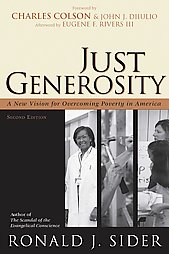
Sorry about the lack of blogging. I will be returning shortly, with more from the book Just Generosity, (see below). For what it's worth, I've been discussing the nature of God's will with someone of a secular humanist perspective on the La Crosse Tribunes comment pages. You can read it here. In contrast to how things normally go on the Tribunes faith section comment section, (a lot of ranting and raving) We are actually having a nicel little discussion, hopefully learning from each other's perspectives.

July 07, 2007

Ch. 2 - A Biblical Foundation (Part 1)

The first part of this chapter lays out a framework within which the author operates. The second part which will follow in the next post, lays out the overwhelming evidence for Christ's concern for the poor and not only the people, but the systems that oppress them.

Assumed is the fact that he is an Evangelical that takes the Bible very seriously. This then is how he views God's hand in creation and the ways in which God involves humans.

Among evangelicals there are essentially two views of the created order. Ask yourself, "do I think the world is created by God, but fallen. (i.e. sinful) Or fallen, but created by God." Sider operates with the latter view. My own view, not surprisingly, follows closely to Sider's. I do have some questions about the scriptural passages that describe the end of the world. However I think the ones that describe the final exaltation of Christ and his creation, a new heaven and a new earth, are entirely too forgotten by evangelicals.

Again, what follows is an outline of the first part of chapter 2 in my own words, except where there are quotation marks.

A Conceptual Framework


The Lord of Economics

We are merely stewards of our possessions. As scripture says, we can not worship both God and mammon. "As Lord of history, God works now, with and through human co-workers, to create more wholesome economies that respect and nurture the dignity and worth of every human being."

The Importance of the World and History
"Many modern secular thinkers absolutize the historical process, even while they pronounce it meaningless. Some Eastern thinkers consider the world an illusion to escape. Some Christians to almost the same thing, viewing earthly life as mere preparation for eternity. Take for instance, the old gospel song, ‘This world is not my home I’m just passing through’."

In contrast, the Bible speaks of creation being restored (Rom 8:19-23) and of the glory of the nations (culture) being brought into the New Jerusalem. (Rev 11:15)

The Nature of Persons
Each person and all of humanity is of an infinitesimal value. Consequently all theories of economics must subordinate themselves to humanity.

We must recognize the freedom inherent in each individual, and the solidarity and the communal nature of humanities shared experiences, locally and globally. “Because our communal nature demands attention to the common good, individual rights, whether of freedom of speech or private property, can not be absolute. The right to private property dare not undermine the general welfare. Only God is an absolute owner. We are merely stewards called to balance personal rights with the common good.

These truths make the exploitation of our fellow humans absolutely wrong. This exploitation can take both overt and passive forms.

The Creation of Wealth
Wealth is a gift from God. Creativity, including the creation of wealth, is one way we reflect the nature of God back to him. How we create wealth, and what we do with it - there in lies the challenge.

The Glory of Work
As God worked so should we, again this is a way we reflect his nature back to him, an act of worship. Laziness is one (on a long list) of reasons people are poor. On the other hand, too much work constitutes evil as well. Be it forced, in the form of slavery or an economy that requires a terrible number of hours worked just to earn a living wage. Or chosen, the common challenge of being a workaholic.

The Reality of Sin
This is the kicker. Everything is marred by sin. There is nothing it doesn't touch, because there is nothing that humanity does not touch. Only when Christ returns will things be completely restored to the way they were created to be. However, that does not mean that that this planet is nothing but a cesspool. Quite the contrary. Ever since the fall, God has been at work restoring this world, humanity and culture, to the way it ought to be, and using humanity to do it.

May 27, 2007

Somebody up there, pray for us

Allan Creech, a very catholic protestant, has a post here about praying to saints. He does a great job explaining our differences and letting us see points of commonality.

Here are his definitions of how protestants and catholics look at death and heaven. I think they are very informative. Among other things he is basically saying, if you would ask your grandmother to pray for you before she dies, why not after she dies?

Protestants = (generally speaking) When someone dies, there is immediate judgement and "sentencing," reward and punishment. Boom! If you have faith in Jesus, you "go to heaven" and in that same swift trip you are glorified, fully and completely transformed (if there is any thought of transformation at all this is when it happens) into the perfect Image of Christ and are ushered into the fullness of the Presence of GOD, without measure, forever. There is also then a separation from the rest of the Body. Maybe it's better to put it like this, a graduation from the Church to something else, the heavenly choir perhaps. There is no more interaction with any of the Church on earth. It's either not allowed or is somehow ontologically impossible, I'm not sure. There's not really any one set theologically worked out argument for why this is. Perhaps there may seem to be the one - that the contrary is not explicitly laid out in Scripture, or is interpreted as not being so.

Catholics = people are still members of the Church when they die, still able to participate, are still being worked on as a matter of fact (but that's another issue altogether isn't it). Catholics believe someone who is "in heaven" is able to hear us and are also able to continue to pray for us to God for help in whatever situation. They believe that a person who is "over there" has, logically, a bigger perspective and greater knowledge, and can intercede perhaps better than someone here. OK. They are NOT called on to believe that such persons have the ability to send powerful help down out of themselves. We're talking about intercession here. It's the continuation of how the Body of Christ works here on earth - I need help, I ask Liz to pray for me because I'm not the complete Christ in myself, she does, this prayer interacts with the great economy of God's Life moving back and forth between the great divide and things happen, somehow. If it doesn't, then let's just all shut up and ke se-frikin-ra, things will just happen and whatever. So, there's that.

April 29, 2007

What is my obligation to those who suffer?

After I sent that e-mail to Brandon, (see previous post) we talked about what i was struggling with the next Sunday. (specifically I'm struggling with the gap between halves and halve nots, and questions on suffering. In this case I have great health and Brandon does not.)

When we had talked the previous Sunday, he wasn't so sure i owed him anything, but after reading my e-mail he could see where I was coming from. However he still had some concerns. The main one was dependency. From the disabled person's perspective, it isn't going to do much good to go around thinking that people owe them. A wow-is-me attitude is a recipe for disaster for the disabled person.

Brandon also wanted to make perfectly clear that I was never going to be able to identify with him in any real physical way. In other words i could have empathy, but never sympathy, which I completely agree with.

Brandon's other concern was a little broader, dealing with the matter of Biblical interpretation. "How does one know they are doing justice to the intentions of the original authors of the Bible and what does that have to do with the hear and now?" was essentially what Brandon was saying, in this case on the matter of suffering and sharing each others burdens. All I'll say here is: exactly.

What Brandon and I finally agreed on is that in his case maybe there is little I can or even should do for him physically speaking, but there are many that don't have the resources he does. Cyra, his wife, is an amazing woman, marrying this man in spite of the condition that has landed him in a wheal chair. (or maybe because of it, I don't know) If anyone suffers right along side Brandon, it is certainly her, setting an amazing example for all of us. Additionally, Brandon owns his own business. He's not rich by American standards, but he has what he needs. Unfortunately this is not the case for everyone who lives life from a chair on wheels. Many many people are not only poor but suffer a great deal do to physical handicaps. So my questions remains. In light of what the scriptures say (see previous post) what is my obligation to those who suffer?

March 27, 2007

The Scandal of the Cross - Conclusions and Implications

A death on a cross is a scandalous, horrific, and shameful thing, something detailed all too well by Mel Gibson's film, The Passion of the Christ. That Jesus died on a cross, and for the Christian, that it was necessary is not a matter of debate, in question is why? (See recent previous posts for more on this.)
Not too long ago it was popular to where bracelets with the letters WWJD. (What Would Jesus Do) The faddish nature of this gradually became appalling, but the initial idea was a fine one, if not a terribly distressing one. (What might the actual implications be?)

The answer to the question, What Would Jesus Do, is given to us in four different gospel narratives, making the answer at times all too apparent. In the end, Jesus died! God died! And before this? He was a poor man, with no place to lay his head. A lowly servant who taught his disciples that the first will be last and the last first, that they must pick up their cross and follow him, that we must love our neighbors as ourselves, and our enemies, yah, we have to love them to.

The common narrative (penal substitution) on the death of Jesus describes Christ’s death as balancing a cosmic account book. One in which all the sins of all of humanity are blotted out by the death of Christ. We then have only to receive this free gift to obtain eternal salvation. There is nothing in this narrative that I think needs to change, rather it is what is not in this narrative that is so terribly disconcerting. The last few posts have detailed a matrix of metaphors by which the cross has been and is being communicated. For most Christians in most places, these metaphors have been refined and simplified down to one controlling view point. “Jesus died to… (fill in the blank)”

In contrast, I believe that Christians would do well to first reengage the cross of Christ devotionally, spiritually, and meditatively. And second, reengage it theologically, examining the variety of historical and contemporary ways the cross has and is being understood. The past few posts have given us a starting point for doing that but are hardly sufficient. None of this theological re-examination needs to undermine orthodoxy or even Evangelical orthodoxy. (Though feel free to question even these assumptions if your so inclined. I believe your faith will be stronger for it.) Rather, a fuller understanding, will, I believe, drive us to radically alter the way we behave.

Previous Posts in this Series


The Scandal of the Cross (5)

In the previous posts we have looked at both the major Biblical metaphors that are used to describe the cross of Christ and the major Theological metaphors. We have also looked at the nature and concept of metaphor.

Biblical Metaphors
Redemption
Reconciliation
Sacrifice
Revelation

Theological Metaphors
Christus Victor Model
Satisfaction Model
Moral Influence Model
Penal Substitution Model

(To be sure there are probably more than just these eight.)

The point of all of this is to illustrate the multiple ways that both the biblical authors and the Church have grappled with the death of Christ. And to press us to likewise grapple with what it means for our God to die on a cross.

I don’t want to get into the myriad ways these metaphors work together and implore us to become more like Christ. That is for you to explore. For now, all I want to say is that I think that these metaphors are best understood as complimentary and incomplete. In many respects, what God did on the cross, and in the cosmos at the same time, is beyond understanding… but not completely, and not to the point of being unintelligible. We have metaphors that make sense. We need to be aware of them and then use them, all of them. (Maybe some more than others, but all none-the-less.) And they need to influence how we behave, as all good theology does.

March 11, 2007

The Scandal of the Cross (4)

The meager paragraphs that follow are hardly sufficient to address the issues at hand. This is more of a “for your information” kind of a post, listing what is out there, and giving us a starting point from which to dialog. Most of you can feel free to read this, say “Oh that’s nice” and move on. It is, however, what I have been musing on lately and so it goes on this blog. If you have the time or inclination, I would love to discuss just how terribly important all of this is, but I doubt that you do. I certainly don’t seem to, as is evident by the frequencies of the posts here lately.

In the last post on the scandal of the cross, we looked at the variety of biblical words and images used to describe what Christ did on the cross. In this post I want to look at the variety of theological motifs available to the church. These motifs have been developed to answer some basic questions.

Why did Christ have to die?

Why did he have to die on a cross?

How does Christ death on a cross save us?

What happened on the cross, spiritually and theologically?

God forgave sins before Christ died. Why then was Christ death necessary? Why doesn’t an all powerful God simply forgive people, without any of this death nonsense?

For the Christian, that the cross saves is not in doubt. But questions about how and why, may still remain, particularly if one chooses to question the Sunday School answers she was given as a child. The answers that follow are theological in nature, not apologetic. Meaning that they are meant to help Christians understand the nuances of what they believe, not convince unbelievers of the truths contained within. What follows is foundational, and academic. It might seem dry, but these are the historical building blocks from which pastors, missionaries and others work. This post gives you access to a few short descriptions, so that we can work from the same sheet of music.

Below I am only going to give you some titles and short descriptions of different perspectives. Its up to you to look into these in-depth if you are so inclined.

Cristus Victor as Recapitulation.
Iraneaus (130 - 202) was one of the first to put forward a theological understanding of the death of Christ. From his perspective, Jesus conquers the devil on the cross, largely by tricking him. As a prize he wins back the rights to humanity. The devil thinks he is defeating Christ by killing him, but in actuality, because the devil does not know the rules, he is sealing his own fate.

Christus Victor as Ransom
Gregory of Nyssa (335-394) taught that Jesus offered himself as ransom for humanity. He gave himself up to the devil, but the goodness of Christ was too much, and the devil lost his grasp, losing his prize as well as his prisoners.

According to both of these perspectives Christ conquers the Devil.

Satisfaction Model.
Created by Anselm (1033-1109) during the middle ages, this model relied heavily on Medieval imagery. Anselm rejected any notion of the devil being owed anything. Rather, Christ offers himself as satisfaction to God for the debt that sinful humanity owed to God.

This model is very similar to penal substitution models that developed later, but due to the different settings they developed in, are in fact, very different. The satisfaction model draws on the obligations that people in various positions owed to each other during the middle ages. For instance, surfs had obligations to the Lord of the manner, and he in turn had obligations both to his surfs to provide protection, and to a king above him, providing the required payments of various goods. Likewise, Jesus satisfies the debt we owe to God, by dying on the cross.

In contrast, the penal substitution model, draws on a system of courts and justice, different than a system of debt and obligation common in the middle ages.

Moral Influence Model
Abelard (1049-1142) was the first to bring this perspective to bear. He first rejects all other notions as described above. He then simply states that it was Christ love for humanity that brought him to earth. Offering us an example of how we ought to live. That he was killed was simply an outgrowth of this, and in his death also he showed us how to behave. In his life and death Jesus drew humankind unto himself by his selfless example, causing us to repent and love God.

Penal Substitution Model
Charles Hodge (1797 - 1878) was one of the first proponents of this model, the most common perspective taught today. It is basically very simple. God would like to live with us all happily ever after, but because of our sins, and because he is holy and just, he cannot. As a solution, God sends his son to earth to suffer the punishment we deserve. Because Jesus paid our penalty, God can now regard us as holy, and commune with us. Many of us have heard the story of the judge that pronounces one guilty of all their sins, but then says, “if you accept the payment that my son has offered” he will bear your guilt and you may go free.

The main difference between this model and the Satisfaction model is that in the latter, Jesus pays a debt we owe, but in the former, Jesus steps in to take the punishment we deserve.

In the coming final post on this topic, we will look at the implications for these models and the one’s found in the Bible detailed in the earlier post.

February 18, 2007

On Metaphor

Before we continue to examine the scandal of the cross I would like to take a brief look at the concept of metaphor and symbol, as it is important to understanding theological discourse.


This is not a boat

It is just a pile of 1’s and 0’s that most assuredly will not float. It is in a sense a metaphor or symbol for a boat, not an actual boat. Furthermore it is a number of other things all together: a picture, a photograph, in this case a piece of art, it could represent history, it is html code, and maybe a few other things as well. One thing it is not, is an actual floating boat.

So it is with theological language. The language, even the concepts are not the reality behind them. The word atonement, event the concept of atonement is not the same as what Jesus actually did on the cross, especially from his and/or God's perspective.

If we want to talk about boats its nice to have a picture of one, but its not the same as sailing. And like wise, when we need to talk about theology (and we most assuredly do need to talk about it) its nice to have word pictures and concepts to use, but it is not the same as the actual reality.

Secondly, boats change. A dugout canoe and an aircraft carrier, they both float in water, but are slightly different. Over the course of time, depending on the needs of the user, boats and metaphors change.

Thirdly, boats and metaphors are bound up in their time and place, and must be used or at least understood in light of their surrounding culture. No one wants to float an aircraft carrier down a river, and a navy man doesn’t want to go to war with a dugout canoe.

All of this comes into play when interpreting the Bible. We can’t just grab words and or metaphors out of the Bible without being cognizant of the authors surrounding culture and his intent. Additionally while we absolutely want to hold on to the original metaphors, we need to realize that, A, they must be translated, and B, they already have been translated, over and over again through two thousand years of church history. This isn’t necessarily a bad thing, just something to recognize and be aware of. (though when done improperly it certainly is a bad thing.)

Additionally, we also bring our baggage to the table. Those of us who have grown up in the church have been raised with X metaphor, or Y metaphor for this or that. Those metaphor’s may have been appropriate to their original audience, (or not) and they may continue to be appropriate in this particular time and place, (or not). (Don’t read too much doubt into that last sentence, I’m just stating that either/or may be true) Consequently, we need to occasionally reexamine if the metaphors we are using, communicate to our audience A, what the original author wanted them to communicate, and B, what we want to communicate. Yes, A and B are often the same thing, but not necessarily. For instance, Paul may address women covering their heads, we may simply choose to only address modesty, or respect.

I say all of this simply to serve as background for the upcoming post on the scandal of the cross, but also for your own benefit in your own future endeavors in Biblical interpretation. I think it also illustrates that though the Bible may be infallible, interpreting it certainly is not.

Do you look at all of this a different way? Please tell me about it.

February 10, 2007

The Scandal of the Cross (3)

As we continue to examine the meaning of the death of Jesus on a cross, I would like to turn next to the word-images that appear in the New Testament narrative. What images did the authors of the Bible use, and what are the implications of those images?

The Biblical authors found it necessary to construct multiple ways of explaining the cross, ways which where bound up in their time and place. All I'll do here is list what those images are, and offer an all too brief word on each. If you are so inclined there is more than you will ever want to read about each one if you click on the link. If I have missed some images used by biblical authors to explain the cross of Christ, by all means let me know.

Redemption
This word gets at the heart of salvation. This doctrine not-so-briefly sums up our standing with God.

Sacrifice
This word gets at the nature and means of God's redemptive work on the cross.

Revelation
The link I have provided for this one is less helpful. Revelation as it applies to Jesus Christ gets at the idea that in Jesus we see most full the heart and reality of God the Father. In other words, Jesus revels God to humanity. Jesus' whole life does this, but nothing so vividly as his death. The death of Jesus illustrates or revels the love of God in a way nothing else can.

Reconciliation
This doctrine sums up what has been accomplished by the other three points. Most Christians are aware of their personal reconciliation with God, however what is taught less often, is the way and degree to which Christ death has the potential to reconcile all things, and in fact one day will, on that day when the lion will lie down with the lamb. To be specific, race relations, economic affairs and humanities relationship with its environment, God's creation, are just three areas that are in need of immense reconciliation. The death of Jesus makes these things possible, in part because of the example Christ displayed for us but also for other spiritual and theological reasons as well.

January 23, 2007

You Damn Liberal

Rodion Romanovich Raskolnikov said...

Wow, you damn liberal. I knew Fuller would mess you up.

Also, are you using a moral example theory of atonement here? Did Jesus die simply so we would all see his selfless act and be energized to be good people as well? This was Arius' view. Be careful not to slip into a works salvation you Catholic sympathizer.

Oh yeah, and see my comment on your last post and check out Irenaeus' recapitulation theory, it's my favorite.

One of my closest friends at seminary is named Greg. He left this comment on the previous post which to the uninformed looks downright rude. But in-fact it was made completely tong-in-cheek. Greg is himself a flaming Roman Catholic liberal, at least in some area's. I can say this because I know him, and because we have shared countless theological conversations. I know precisely the look on his face as he wrote this. As he wrote, he wore a sly mischievous grin, one which I miss very much. In this grin Greg communicates any number of things, but one of them is this: “I a roman catholic know what I think, and you a conservative (kind of) evangelical know what you think, yet in spite of our sometimes large differences we press on with a contagious kind of love. A love for theology, each other, and most of all Jesus Christ that allows us to be worlds apart but best of friends” (yes all of this is communicated in Greg’s grin.)

Looking back on our time together at Fuller. I think that one of the things that made this possible was our lack of desire to win a debate. We were both so committed to our positions that we would just sit around chatting, sometimes passionately, but never really debating, just talking, learning from each other, what the ins and outs of each others positions were. Ironically, in trying not to debate each other, we did in fact rub off on each other.

Interesting yet disconcerting is the fact that what we chatted about over beer and cigarettes, others have literally (and I mean that) killed over.

I responded to Greg's comment as follows:

Greg, I don't think any of this will be news to you, but I'll say it anyway. Jesus didn't die simply so that we would all see his selfless act and be energized to be good people as well, he DIED so that would all see his selfless act and be energized to be good people... and so much more. Yes there is a line of reasoning that would suggest that Jesus was just a good teacher and that his death sealed this teaching, catapulting them to the next level if you will, and that Peter and Paul then invented Christianity on the back of this "good mans deeds". What is different here is that I am saying not "yes, but" but rather "yes, and" The good teacher, (who was also the Son of God) sealed his teachings, our example, and did a great number of other things as well. These "other things" I believe can be grouped or described under three broad categories, anthropologically, kind of what the previous post was getting at, and theologically, which we do too narrowly, and spiritually. You and I both believe that on the cross, something amazing happened at a spiritual/supernatural level that mere theological discourse fails to get its arms around. What Jesus did on the cross fails comprehension at so many levels it should stop us in our tracks. Instead we summarize it in neat theological statements and package and sell it for only $9.99 on necklaces and bookmarks at the local book store.

January 19, 2007

The Scandal of the Cross (2)

On the cross, Jesus accomplished a number of things, a wide variety of things that we tend to boil down to a simple explanation. This is very unfortunate. By simplifying what Jesus did on the cross to a simple statement like, “Jesus died for my sins.” Or “Jesus’ blood covers my sins”, we do not do justice to the degree to which Jesus’ death turned the world upside down. What follows is just one of many other things that Jesus’ death accomplished.

The Roman world was based on patronage, people doing what was expected of them by others. Everyone had expectations. Slaves were indebted to their owners, sons to their fathers, the Elite to the Emperor, and the Emperor to the gods. Gifts and favors were given with an expectation of a return on the “investment”.

In contrast to this, Jesus set forth an alternative ethic, one in which we “die to ourselves take up our cross and follow him.” This ethic is found through out the gospels. For instance, we see the disciples fighting among themselves over who is the greatest. Jesus responds by saying that the last shall be first and the first shall be last. During the sermon on the mount, over and over he says, “you have herd it said, but I say unto you…” He invites the little children to come to him with out reservation, and shortly before he dies, he takes on the role of a lowly servant, washing his disciple’s feet. The teachings of Jesus have turned and are turning the world as we know it upside down.

Now none of these teachings constitutes something new for those of us who identify ourselves as Christians, but how far would these teachings have multiplied if Jesus had not died a horrible death on a cross? They would be lost. By making the ultimate sacrifice, Jesus set his other teachings and examples in concrete, causing them to be immovable objects. As Paul puts it “we preach Christ crucified: a stumbling block to Jews and foolishness to Gentiles.”

To draw an analogy, the life and teachings of Jesus are like a demolition team setting up a building for demolition. If the effort of the demolition team over the course of weeks doesn’t result in a gigantic explosion, bringing an old building to the ground, their effort is for not. Similarly, if Jesus hadn’t died, his teachings and life would be like a demolition team setting the charge but not igniting the fuse. If Jesus hadn't died, would we even know his name?

His teachings have changed the world, and continue to change the world, but none of this would be true if he hadn’t died the way he did. If his teachings had endured, but he hadn’t died, there would be a point at which we could say, “this far and no further, I am willing to give this much up, but no more.” Instead, because Jesus is our example, and because he went all they way, we have no option but to also go all the way… whatever that might mean. : )

January 13, 2007

The Scandal of the Cross (1)

What did Jesus do on the cross? That is the question I would like to examine in the next few posts. I'm reading a book, Recovering the Scandal of the Cross - Atonement in the New Testament and Contemporary contexts. And in the up-coming posts would like to explore the implications of what both the authors, and the Bible itself says about the meaning of Christ's death on the cross.

The back cover says: "The New Testament displays a rich array of interpretations of the cross. These were shaped by the church in mission as it rooted the saving story of the scandalous cross in the language of every day realities and relationships. But for many Christians today, not only has the true scandal of the cross been obscured, the variety of its New Testament interpretations have been reduced to a single, controlling view of the atonement."

A question: how would you describe what Jesus did on the cross? Not physically, but theologically. How would you alter your description if you were addressing believers, verses the un-churched?

December 24, 2006

What Matters (2)

Luke 9:27
Love the LORD your God with all your heart and with all your soul and with all your strength and with all your mind.

So here is the other side of the coin on that last post. Theology, philosophy, biblical studies, they matter… a lot. How much is “a lot” is the question. One of the things I appreciated about the profs at Fuller is that they would take the “out there” the philosophical, and the like, and make it relevant. They would connect the dots between the seemingly irrelevant, and the deeply personal.

For instance, the question “how many angels can dance on the head of a needle?”, is a question that mattered a great deal to theologians of the middle ages, and is a question often held up as the height of inconsequential theological musing. The actual question behind the one just stated is, “are angels physical beings?”, things we could in some way get our hands on, beings that have a place in our scientific world, or are they purely spiritual, very real dreams if you will, things that though significant and real, are not real.

This may seem like an inconsequential question… until you have a dream in which angels speak to you.

The original question about dancing angels also raises question about the entire physical world and it’s relationship to the spiritual world. How do these things interact? What may seem initially irrelevant becomes paramount for the person terribly in need of a miracle.

This is all just one example of making the philosophical, personal. Taking the irrelevant and bringing it home, illustrating its significance to our larger web of beliefs. Concerning the previous post, what I am finding is that this is best done with the help of the Holy Spirit, and with Jesus Christ at the fore.

December 22, 2006

What Matters

1 Corinthians 2:1-3
1When I came to you, brothers, I did not come with eloquence or superior wisdom as I proclaimed to you the testimony about God. 2For I resolved to know nothing while I was with you except Jesus Christ and him crucified. 3I came to you in weakness and fear, and with much trembling.

One should not take this verse too far, and one should not base much of anything on one passage, but it non-the-less represents very succinctly one of the directions I'm moving in, focusing more and more on Jesus Christ, and not on the minutia of theology, biblical interpretation, and the like. Though these things should not be set against one another, in practice, they often seem to be.

What am I getting at?

What I'm trying to say is that it appears to me, that the things that the Bible says a great deal about and the things Christians disagree about are not similar. We go to great lengths to discern the profound and the deep, while what Christ and the Bible seem to say most, we do rather poorly. I say this without hesitation because It seems most true in my life. I know something of the details of theology and the like, and do too little about what seems to be the more important things.

Everything I've just said has been said before and said better, (and please please don't here some type of fake holiness in this statement or anything earlier) However what might be mildly novel is that I find all of this very disconcerting. I wonder at times if the evangelical church/culture isn't more like the pharisees than we would like to admit. Maybe most of what we do is incredibly irrelevant. Naturally this begs the question, "what is relevant" and by "relevant" I don't mean "hip" or "cool", I mean relevant in a deep way, the things that cut to the core of who we are and what matters. Unfortunately on this matter I don't have an answer either. Some thoughts yes, but unfortunately, no answers.