What does the first picture (in a symbolic sense) have to do with the second? What does the church have to do with genocide, abortion, global warming, cancer, AID's, and on and on it goes. It is a question that haunts me. This is why I am something of a cynic. If I go there it breaks me up. So I just don't go there.
July 11, 2007
The Question That Haunts Me
What does the first picture (in a symbolic sense) have to do with the second? What does the church have to do with genocide, abortion, global warming, cancer, AID's, and on and on it goes. It is a question that haunts me. This is why I am something of a cynic. If I go there it breaks me up. So I just don't go there.
July 08, 2007
American Perspectives on Poverty
Below are some excerpts, but what it more interesting is the conversation that ensued in the comment section. It's pretty interesting. The conversation between John and NWProdigal illistrates an escatelogical tug of war between those that see the present world as having little to no value because it will all be swept away, and those that believe that Christ is making all things new, redeming the present. Both sides argue well, making the conversation very informative.
Post Excerpts
Three out of four adults (72%) consider poverty to be one of the most serious social problems facing the United States today. That includes one out of every five adults (21%) who contend that poverty is the single, most serious social problem of all. Just 4% argue that poverty is not much of a problem in the U.S. Evangelical Christians were only half as likely (11%) as the rest of the adult population to deem poverty to be the nation’s most vexing social challenge. Asian Americans (11%) were similarly less likely to see the issue in this way.
Two-thirds of Americans (64%) consider poverty to be an issue that the government is primarily responsible for addressing. Nearly one out of five people (18%) say it is the primary responsibility of each individual citizen to address poverty. Much smaller numbers of people say it is the duty of churches (4%), non-profit organizations (4%) or businesses (3%) to take the lead on dealing with poverty.
Evangelicals were among the groups least likely to see poverty as a job for the government (55%) and were the group most likely to see it as a matter for churches to address (14%).
Comment Excerpts (you should really read the whole conversation in context)
NWProdigal: I would much rather give my money to missions that promote the gospel to people that haven’t heard it, than to spend it on thankless people who have heard of God, but want nothing to do with Him. Then again, we are told to be like God, and not be a respecter or judge of those outside the fellowship. So, while I too am cynical about giving to thankless people, we cannot be Christians and allow people to be homeless or hungry who are in that position through bad judgement, addiction or bad luck. But, I have no desire to help those who can work, and won’t (see Romans 4:5).
John: Rick, those statistics are interesting. I personally feel I have gone (and continue to go) through conversions in my faith. Perhaps the greatest awakening for me is the realization that my faith is not about what happens to me after I die, but about participating with God to put the world to rights (if I can use NT Writ’s language). This means that issues of systemic poverty, injustice, and oppression have become my mandate beginning right here in my own back yard.
To answer the question of how to get more believers to understand this: we stop preaching a gospel laden with afterlife benefits and “here and now” blessings of happiness and comfort, and begin to call people into the greatest adventure of healing all creation.
NWProdigal: All I am saying is that this ecological and social justice approach to Jesus is somewhat valid, but the true purpose of Christianity is not to save the present world or earth, but people’s souls.
John: NWP, I can’t buy into a dualism that contradicts the very reason for the incarnation and the very first doctrine of the bible that proclaims that all creation is good. The kingdom is overlapping and interlocking with the here and now…that is the Kingdom message that got Jesus killed. It is not (just) about some afterlife place that is disconnected and disembodied from the texture of the world we are living in. To go extremely in the direction of focusing only on the heavenly is dualistic and resembles gnosticism. The challenge is that the gospel is calling people into the hope of the future of a new heaven and earth by inviting people into the family (church) to reflect the very image of the creator here and now…by his image i mean the nature and attributes of the trinity..all of them, not just the easy ones. Sometimes we too narrowly cling to the niceties and forget how close to God’s heart dealing with systemic injustice and oppression are.
Too many in our western christian culture reduce the gospel to mere personal piety as they strive to be nice people like Jesus…hoping they have done and said all the right things to ensure they are “in”. Not realizing that they are denying the more important elements of the law like justice and mercy.
“You will always have the poor among you” has been the defacto cop put verse that Christians use to justify their inactivity. Yet that type of behavior resembles more the traditions of Karma that suggests that those suffering have made their own bed and are under judgment. (emphasis mine)
July 07, 2007
Ch. 2 - A Biblical Foundation (Part 1)
Assumed is the fact that he is an Evangelical that takes the Bible very seriously. This then is how he views God's hand in creation and the ways in which God involves humans.
Among evangelicals there are essentially two views of the created order. Ask yourself, "do I think the world is created by God, but fallen. (i.e. sinful) Or fallen, but created by God." Sider operates with the latter view. My own view, not surprisingly, follows closely to Sider's. I do have some questions about the scriptural passages that describe the end of the world. However I think the ones that describe the final exaltation of Christ and his creation, a new heaven and a new earth, are entirely too forgotten by evangelicals.
Again, what follows is an outline of the first part of chapter 2 in my own words, except where there are quotation marks.
A Conceptual Framework
The Lord of Economics
We are merely stewards of our possessions. As scripture says, we can not worship both God and mammon. "As Lord of history, God works now, with and through human co-workers, to create more wholesome economies that respect and nurture the dignity and worth of every human being."
The Importance of the World and History
"Many modern secular thinkers absolutize the historical process, even while they pronounce it meaningless. Some Eastern thinkers consider the world an illusion to escape. Some Christians to almost the same thing, viewing earthly life as mere preparation for eternity. Take for instance, the old gospel song, ‘This world is not my home I’m just passing through’."
In contrast, the Bible speaks of creation being restored (Rom 8:19-23) and of the glory of the nations (culture) being brought into the New Jerusalem. (Rev 11:15)
The Nature of Persons
Each person and all of humanity is of an infinitesimal value. Consequently all theories of economics must subordinate themselves to humanity.
We must recognize the freedom inherent in each individual, and the solidarity and the communal nature of humanities shared experiences, locally and globally. “Because our communal nature demands attention to the common good, individual rights, whether of freedom of speech or private property, can not be absolute. The right to private property dare not undermine the general welfare. Only God is an absolute owner. We are merely stewards called to balance personal rights with the common good.
These truths make the exploitation of our fellow humans absolutely wrong. This exploitation can take both overt and passive forms.
The Creation of Wealth
Wealth is a gift from God. Creativity, including the creation of wealth, is one way we reflect the nature of God back to him. How we create wealth, and what we do with it - there in lies the challenge.
The Glory of Work
As God worked so should we, again this is a way we reflect his nature back to him, an act of worship. Laziness is one (on a long list) of reasons people are poor. On the other hand, too much work constitutes evil as well. Be it forced, in the form of slavery or an economy that requires a terrible number of hours worked just to earn a living wage. Or chosen, the common challenge of being a workaholic.
The Reality of Sin
This is the kicker. Everything is marred by sin. There is nothing it doesn't touch, because there is nothing that humanity does not touch. Only when Christ returns will things be completely restored to the way they were created to be. However, that does not mean that that this planet is nothing but a cesspool. Quite the contrary. Ever since the fall, God has been at work restoring this world, humanity and culture, to the way it ought to be, and using humanity to do it.
July 02, 2007
Ch 1- What Does Poverty Look Like
Mention poverty and many people in the
Thirty year ago, half the poor lived in rural areas. Today, only twenty-five percent do. Poverty is growing fairly rapidly in the suburbs (especially the inner suburbs) where thirty-three percent of the poor now live. Only twelve percent of the poor live in urban ghettos—defined as an area in which at least 40% of the residents are poor.
What Causes Poverty?
Structural Causes
Decreasing Number of Low Skilled, Well-paying Jobs (Factory Jobs)
Falling wages - including the buying power of the minimum wage.
The structure of welfare and it's ability to help someone out of poverty.
Racism
Personal Decisions and Misguided Behavioral Patterns
An Increase in the Number of Single-Parent Families
Illegal Drugs and Alcohol
Sudden Catastrophes
Accidents and illness leading to permanent disabilities, especially to the primary bred-winner.
Medical bills in the hundreds of thousands of dollars that can not be paid.
Consider the Distribution of Income and Wealth
In 1974 the bottom 20% of the population received only 5.7% of the total national income, while the top 20% enjoyed 40.6%. In the next 20+ years, and inequality became worse. The bottom share dropped to 4.2% while the top share expanded to 46.8%.
Nor is it just the poor who are seeing their share of income decline. From 1979 through 1997 only the top 20% saw their share of income grow. Everyone else, the other 80% saw their share of income fall.
In 1965, CEO’s made approximately 44 times the salary of the average factory worker. Thirty years later the CEO received 209 times the average factory workers salary.
Conclusion
Poverty is alive and well in the
The rest of this book offers a comprehensive vision of how a committed movement of people with the Judeo-Christian perspective can dramatically reduce agony and injustice by offering the poor genuine opportunities to work their way out of poverty.
June 16, 2007
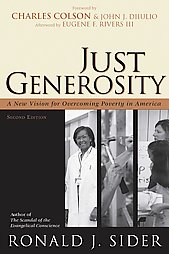
Just Generosity
The back cover says: Ron Sider, author of the best-selling Rich Christians in an Age of Hunger, calls believers to care as much about the poor as Jesus did. He offers a new, holistic approach in which much expanded faith-based groups work with business, media, and government, uniting inner spiritual transformation and correction of structural injustice, to help end poverty in the world's richest nation.
June 09, 2007
Don't Always Give Your Best
Mason: I'm a coach. And sometimes what I see and experience makes me think, "Is it all about winning and losing? Is that the greatest purpose of what I do? Or of sports?" Maybe it's about giving your very best. If you believe that God created you, don't you think you owe it to Him to give your best? Even if you don't believe that, don't you at least owe it to yourself? I don't remember the times I won or lost so much as the times I gave it my all or just gave up...
David: ...there is almost always room for improvement, always something else you could do. How good is your best? With your track athletes for instance, at some point they quit working out and move onto other activities, other good activities. studies for instance.
I would liken it to propelling a vehicle. The best millage to speed ratio is 55mph. After that you can go faster, but it will cost you. And so it is with "giving your best" you can but it will cost you, often time, time that could be used on something better.
Mason: That's all fine Dave, but yours is a question of priorities. My comments are geared towards someone who has already made that decision, whether it be a workout or a competition. Once you have decided to use your time for that activity it only makes sense that you should give your very best. And your comment about not always striving for an A? That's weak. I'll quote a track & field legend. "To give anything less than your best is to sacrifice the gift" - Steve Prefontaine
David: Prefontaine's quote is representative of a broader American ideal, often called the protestant work ethic, which stems from a theology that everything, including work, should be done to the glory of God. (John Calvin and others) On paper I agree with this, but I feel strongly about what happens when this good idea goes too far. Hence my concern over as you say, priorities.
I really believe, and I think you'll agree, that our priorities are pretty screwed up in this country. (i.e. workaholics/latch key kids) Part of that problem comes from an over-competitive nature, and a desire not to "sacrifice a gift" which on the good side has propelled this country beyond all others by some measurements, (economic) but at what cost? (spiritual/ethical)
At the end of the day I'm not saying your original post was wrong. All I'm saying is that you should not ALWAYS give your best.
June 03, 2007
Stranger Than Fiction
(yes I got paid to say all of this...)
(...no not really, your way too gullible)
This post is an example of what happens when a theology geek goes looking for spiritual themes in all the wrong places. (which yes, are often the best places) This is a film that thematically speaking, depicts many aspects of the life of Christ well. For me personally, I walked away from it closer to Christ.