Check out our new car, a 91' Honda Accord EX, fully loaded with 120,000 miles. It's a replacement for the one a drunk driver totaled a week ago. If you want, you can see some more pics here.
91' Honda Accord EX
This weekend a drunk driver slammed into our parked car, (which we were not in) as it sat on the street in front of the house.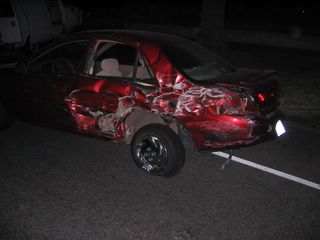 The collision with our car caused him to spin out of controll until he came to a sudden stop at the foot of a tree, which caused his van to collapse in on him, nearly killing him. The van was full of cement mix and tools making it very heavy, which combined with his aproximate 55mph speed (in a 40 zone)combined for a great deal of energy. The paramedics didn't think he would make it to the hospital, though two hours latter we received word (as we waited for the tow truck) that he did not have to undergo any emergency surgery which is usually a good sign.Funny how these things play games with you. I usually don’t leave the car out front, and if I hadn’t he probably would not have ended up in the emergency room. I don’t blame myself at all…intellectually, but none-the-less the incident still tried to play “what if” games with my mind. I suppose this is a good thing, allowing me to relate ever so slightly with people that have experienced truly traumatic events for which they feel responsible, even though they are not.
Below are a few interesting excerpts from Counseling in Context, written by David Atkinson and Francis Bridger, the latter of whom is the proff for my class, Ethics of Pastoral Care and Counseling.Is it legitimate to use the term ‘Christian counseling’, over and against counseling in general? Should we speak simply of ‘counseling by Christians’ which lays the emphasis upon the distinctiveness of the counselor rather than the process or context of the counseling? Or should we speak of ‘counseling in a Christian context’? (p. 23)Are psychology and theology to be regarded as friends or enemies? Should they operate as alliance or antithesis? (p. 42)Our starting point must be to acknowledge that the theological and philosophical context in which counseling takes place is rarely made explicit. Few counselors receive either theological or philosophical training and although some leading counseling theorists have recognized that mere therapeutic technique is not enough, at the day to day clinical level, most counselors operate without looking at their presuppositions at all. Counseling is perceived as dealing with real people in the real world with real problems. Theology and philosophy are perceives as dealing with high-flown abstractions. We shall try to show that far from being irrelevant to counseling, philosophy and theology are essential. (p. 53)
Today in class, we were talking about, among other things, the loss of moral authority that modernity took from the powers that be; society, government, church, etc…I wonder, did modernity take the authority from the powers, from the church in particular; or did the church forfeit its authority even before the enlightment? If it is the latter, have we done anything to earn the authority back?Should we even want the authority back?Don’t misunderstand me. I do believe that God is the absolute authority over everything…but the church…I don’t know if it should have or want any authority. Which should not be misconstrued as me saying unequivocally I don’t think it should or does have moral authority. I am simply asking questions.What do you think?
Does the church have moral authority?
Should the church have moral authority?
I try to continually integrate my classes with my personal spiritual growth, the ongoing conversation that is my Christianity. Sometimes I’m successful, and sometimes not. In class today we were considering the theological answers to the “why me, God?” question, and in doing so I had an awesome awareness of the presence of the Holy Spirit. The non-answer according to Dr. Bridger lies first and foremost in the cross, and it was here, reflecting on what happened on Calvary, that that which is wholly other, the Holy Spirit, manifested himself in a beautiful way.I said "non-answer" above because for the person that is suffering, there is no good answer to the "why me?" question that you or I can provide. All our theology, valid as it may (or may not) be, will only melt at best, and may cause great harm for the person who is at the preverbal end of their rope. (though this is not to say that the counselor should not have a theology of suffering)
Only the Holy Spirit can speak into horendous circumstances, and though He may use you or I to do so, the "peace that passes all understanding" comes only from Him.
Side note: What is the one who perpetually suffers to do with the praise songs that tend to dominate many church services? I believe that worship leaders need to reengage the laments found in the Psalms. We are supposed to both cry with those that are suffering and laugh with those that laugh, but it seems that we usually have a lot more of the latter, at the expense of the former.
My last class of the summer is here, and will occupy my mornings (8am-12pm) for the next two weeks. It’s entitled Ethics of Pastoral Care and Counseling, and so far I’m loving it. It is taught by a Dr. Francis Bridger, an excellent professor who insists on being called Francis.The course description reads thus:This course is designed for those who wish to become more effective pastoral practitioners. It aims:• to enable students to bring together theological and counseling insights from a practitioner perspective.• to address such topics as: the nature of pastoral care; the importance of ethics for effective pastoral care and counseling; the counselor as ethicist; issues in the professional ethics of counseling; learning from codes and guidelines of churches and professional counseling organizations; developing frameworks for Christian ethical practice; ethical problem-solving.• to develop practical skills in pastoral casework from an ethical standpoint.
Are you a Fundy (fundamentalist) hater, or a Fundy lover?
Regardless of your oponion, you will probably appreciate one of the assigned readings from my church history class. It gives a great commentary on Fundamentalism, Evangelicals, Fuller Seminary, and our current setting. Incendently it also communicates the direction I am going in. Hope you will check it out, it’s by some guy named Rich. ; )

