The problems with Obamacare are well documented. And they are real. People have a right to be upset with the roll-out of the ACA. But the fundamental premise that all Americans should have access to healthcare is being addressed, and it reflects a value for life and justice and generosity.
This article in the New York Times details some of the promises and ongoing problems of the ACA.
In some cases, those most vociferous on the problems are those that have done everything they can to derail it. They are like a neighborhood bully who, having just rammed a stick through the spokes of a little boys bike says, "see I told you you would crash."
And then there are those who say, "we aren't opposed to access, we are just opposed to this approach." But were were these people for the 20 or 30 years that this problem developed? Obamacare addresses problems that were well documented and not being addressed. Those problems could have been addressed in some other way in the years prior to Obama being elected. If churches and non-profits should be at the forefront of this effort, why weren't they? Or why wasn't their effort adequate? Why wasn't their enough of them? Or did they do the best they could and the inadequacy of the effort prior to Obamacare just illustrates the limits of this approach? (I'm not judging the efforts of those who were involved in non-profit healthcare prior to the ACA, I'm talking about the systemics of it.)
Finally there are criticisms of cost. Several things are happening here. First, American's are being asked to pay the real cost of their healthcare. (Or something closer to that number.) In some cases, people were getting more than they were paying for. Second, people are getting an insurance contract that is fundementally better than it was for many in the past. The situation is similar to regulations on automobiles. In some parts of the world, you can get a new car for substantially less than you can here in the States, but the workmanship, safety and efficiency all suffer. You take your life in your hands driving these cars. In the same way, people who use to have low-cost insurance plans, more than likely did not realize the extent of the exclusions and limitations on those plans. In some cases they were paying for an insurance contract that was not worth the paper it was written on. Having said this, this is one area I could see agreeing with conservatives. Maybe American's should be free to buy bad insurance contracts. I could see offering a super low-cost insurance contract that came with the equivalent of a Surgeon General's warning. "Warning! This contract does not comply with the requirements of the ACA and contains significant limitations, including..."
Having said all this, the problems at present are real. Good intentions are not enough. President Obama and his deputies need to deliver on the promises they made because those promises reflect a concern for life, and justice, and generosity.
Showing posts with label poverty. Show all posts
Showing posts with label poverty. Show all posts
January 01, 2014
April 01, 2012
What gets preached AND what does not - From the pulpit AND in my life.
I wrote the following to a friend this mourning and thought I would share it with the rest of you. (with a few edits) It is about me, not him, so no worries on confidentiality. Read this as a letter to a friend.
...But to be fair, I am a bit cynical in some respects. It is something I reflect on fairly often with the Spirit in my quiet times. How does one see the world as it really is... ideally through His eye's, and not become cynical?
I was visiting a church the other day and they were preaching on God's immutability. Malachi 3:6a was referenced. “I the LORD do not change."
Clearly there was nothing wrong with what was being preached. And God's character was being made appropriately relevant to the hear and now. But like usual I briefly scanned the rest of the chapter, and a problem immediately jumped off the page.
The issue I saw was not necessarily one for any given church, or any given sermon, but rather concerns our shared Evangelical culture. The issue that leaped off the page at me was what we preach, thematically speaking, over the course of a year, and what does not get preached over the course of a year.
Malachi 3 is a perfect example of this.
(Go ahead and read it here, it won't take long.)
Things more than likely preached over the course of a year.
Mal 3:5a - sorcerers, adulterers are evil - check
Mal 3:6 - God does not change- Check
Mal 3:8-9 - Tithe - Check
Mal 3:17-18 - God's Compassion - Check
What got skipped?
The latter half of Mal 3:5 - "So I will come to put you on trial. I will be quick to testify against sorcerers, adulterers and perjurers, against those who defraud laborers of their wages, who oppress the widows and the fatherless, and deprive the foreigners among you of justice, but do not fear me,” says the LORD Almighty."
September 23, 2011
Justice like a River: Why development needs justice
Moving stuff in this article, Justice like a River: Why development needs justice by Jamie McIntosh and Hiroko Sawai
For those of you interested in international law or development, this is both interesting and saddening. The article lays out several different areas where a lack of justice leads to increased poverty and suffering. Fortunately it goes on to describe some of the solutions as well. The authors have found that the case model, working with people at the ground level, is having a significantly better effect than broad efforts at judicial training and reform. It seems these efforts are often a mile wide and an inch deep, whereas getting into the details of specific cases helps to establish precedent and makes an example for others to follow... or rightfully be afraid of.
Selected excerpts.
Introduction
Without legal protection from violence, the lives and the livelihoods of the global poor are at perpetual risk. Four billion people on our planet live in that risk.
November 03, 2010
How my continuing engagement with Scripture changed my views on public policy
In the 2000 presidential election, I voted in my first presidential election, and as a newly minted member of the U.S. Air Force, was very happy to see President Bush elected. And in the time before facebook and blogs, I e-mailed news articles to friends, often with my commentary, almost always with a conservative slant. So when I say that I have shifted to the left, that should be considered relative. I am pro-life and believe in smaller, smarter government, but after that, I tend to favor if not progressive policies, certainly a lot of progressive values that I see reflected in scripture.
August 16, 2010
Christians of Every Stripe Calling for Immigration Reform
You may be surprised to find out that churches of nearly every denomination and tradition are speaking out with one voice on immigration.
Together they are calling on the Federal Government to reform our present immigration laws.
Consistently, they are calling for three things.
Together they are calling on the Federal Government to reform our present immigration laws.
Consistently, they are calling for three things.
- That immigrants be treated fairly, humanly, with dignity and respect.
- That the rule of law be respected, and shaped to meet the above standards.
- That we recognize that we ourselves are immigrants; that as Christians we come from a tradition of immigration, and that we therefor head the words of scripture, welcoming, loving and caring for those in need, including the immigrant, regardless of legal status.
Following are the statements on immigration of no less than eleven diverse christian organizations. Catholics, Evangelicals(2), Lutherans(2), Methodists, Presbyterians, Southern Baptists, and Episcopalians.
March 29, 2010
What Comes First, In Health Care, and Everything Else
Been talking some with a good friend of mine, David Baxley, about the whole health care debate. He and I see things differently, but what I like about David is that he tries to put his theology first, and then his politics. He tries to understand his God and then allow that relationship to shape his relationships with everything, and everyone else, including his politics.
I wonder, do you and I do the same, or are we first Conservative, or Progressive, a Man or a Women, a _________, whatever label you want to use, and only after that, a Christian, a Jesus follower?
I wonder, do you and I do the same, or are we first Conservative, or Progressive, a Man or a Women, a _________, whatever label you want to use, and only after that, a Christian, a Jesus follower?
Do we make God in our image or are we allowing him to shape us into his image. Do we read the Bible looking for those progresive verses, those conservative verses, or do we recognise the Bible for what it is, a story meant to help shape us into the image of Christ. Something meant to shape, not be shaped.
December 13, 2007
The Role of Civil Society (2) (and last)
I kind of got off on a tangent there at the end of that last post. On a more positive note, Sider's comments about the potential of Civil Society give me the most hope, and I believe, offer us the most potential. Sider considers everything that is not directly controlled by the government to be part of civil society. Things like businesses, universities, faith communities, social clubs, and other non-profit organizations. One place I slightly disagree with Sider is his lumping of the family in with the rest of civil society. True it is not controlled by the government, but in my mind it is so unique and so foundational, that it needs to be it's own category.
Theologically, I would want to put the Church in it's own special category as well, as a Christian I want it to be all that it can be, an entirely unique community, united and filled with the Holy Spirit. One that is so ubiquos as to be a part of everything else we do. Not the Church as institution but the church as people, living and being the people of God. However from a public policy perspective, I would go ahead and group the actual churches we have, the governing bodies, warts and all, in with mosques, and synagogues, that is, faith communities. And then group those as one category that is part of Civil Society.
In my mind then, there are three primary prongs of attack on the issue of poverty. In no particular order, Family, Civil Society, and Government. I would add that personal choices and responsibility are a theme that must be emphasized within each of these areas.
Going back to Sider and his value for Civil Society, like we were saying, this may be the area with the most potential for overcoming the policy deadlocks we are in. Conservatives trumpet personal choice and the family, good. Progressives, the government, good. Hold on to that. THEN, hit the accelerator with this third avenue of approach, at least in this country, we are gaining ground, but all too slowly. Civil society has the potential to put us over the top. These institutions are largely untapped resources in a fight for justice for the least. Granted, many organizations within the realm of Civil Society have ending poverty or a similar goal as their primary end, but what I mean is that as a comprehensive avenue of attack, these resources are largely untapped.
Two of my favorites are business and education. Non-profits and faith communities working against poverty is a given, but business and education, now there is some room for growth. In an information society, education and continued education are what land was to most previous generations, it is a key to unlocking a great deal of potential and resources.
On the business front, while I often come off sounding like a communist, (cause Jesus sounded like a communist) the power of the "market" and the principles of business are tried and true, and can help end poverty when brought under the Lorship of Jesus Christ (or possibly ethics in general, for the larger public). I firmly believe that attacking poverty through charity is incredibly limited. Don't get me wrong, it has a place, but I think the hard truths found in business, a place where the balance sheet must be reconciled, has a great deal to offer the least advantaged. (Now I'm starting to sound like a Republican, I know.)
The 19th century showed us business as it's worst. A world ruled by oligarchs who had money and power as their primary end, and a world in which government was largely unable or unwilling to stop the abuse of the the poor. (think child labor, brutalized mine workers for example, and the horrible excess of the rich and powerful.) Government regulation helped bring an end to this. Now, leaders who are ethically grounded (I would argue for Christian ethics, but even without that.) these leaders are showing us a new way forward. A world where ethics, and economics collide and are utilized to help end poverty.
The idea that businesses can help end poverty is grounded in scripture, most specifically, the Mosaic law. In that agrarian culture, the land owner/farmer was required to leave the corners of their fields unharvested. Then the poor would come out and "glean" that is, harvest those corners. Role that into the 21st century.
One: Gleaning was a law, i.e. government regulation. Government regulation can be an excellent thing for the fair minded business owner because it creates a level playing field by forcing everyone to do the right thing, a right thing that assists the poor. I may want to pay my workers higher living wages, but I literally cannot because my competition does not, (can you say Wallmart) and frankly I as a business owner, particularly a small business owner, may not be getting rich, I'm barely making it. So I really can't pay what I ought to pay my workers, and make any profit in many instances. But when the government mandates an even playing field, one that includes fair and living wages, then I can do the right thing, the thing I want to do, and compete with my competitors based on other real factors. Things like cutting costs (other than in the payroll), quality, or innovation.
Two: Gleaning involved work on the part of the poor. They had to literally get up and go get their food. There is a place for free handouts, say from the church as a way of mediating grace, or for those that literally can actually not work, but the principle of gleaning involves working for your food, as one generally should. (Unfortunately, so many in this country are working over 40hrs/wk and still hardly making it. For those people, we find the church and government compensating for the evils of the "market".)
Three: Where did this "charity", this free food that was gleaned come from? From a profit. Profit is not a bad thing. Neither is wealth put to work, (i.e. money invested and/or gaining interest) It is wealth squandered on indulgences and the laziness and entertainment of the wealthy while others starve that is evil and which God condemns with the strictest penalties.
I am very interested in the science of economics. Though I don't know a great deal about it, I think it is fair to say that if we all gave everything away... (and followed Jesus?) Who would provide for the "all of us" that were being blindly and naively spiritual. That is not what Christ wants. (from all of us anyway, however he may want you to be a monk.) Rather, it is creating a culture, an economy, a world, in which the Biblical concepts of justice, love, and grace, are followed and balanced in such a way that no one need suffer the worst effects of poverty. Should one suffer consequences for poor choices, of course. But there is such a thing as grace and forgiveness. Moreover, the majority of people who are suffering today are suffering from a combination of poor choices and unjust systems. And for quite a few it is something like a debilitating disease (and the cost associated with it) or a poor local economy that is wrecking the most havoc.
Many people find themselves rock climbing without a rope. The culture/government mandate that one climb the cliff, but does not provide the necessary safety equipment. Then when one makes a poor personal decision, "sins", uses drugs, takes out a loan they can't repay, or just as often simply "slips", gets injured, or laid-off from their job, they fall to their financial death. They "sinned", they made poor personal choices, but the fact that that results in financial death, whose fault is that?
December 02, 2007
The Role of Civil Society
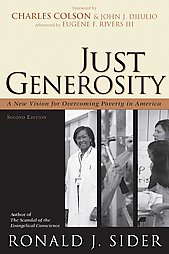
What follows is the final post in this series on Ronald Sider's book Just Generosity. It is a synapse of the third chapter, A Comprehensive Strategy.
A Policy Impasse
Progressives offer government as the answer to poverty. Conservatives offer family values and right conduct. The truth is a combination of these things. When Progressives openly attack faith communities and ignore the value of the family, and conservatives ignore the debilitating effects of unjust systems, some large corporations, and the potential of some government intervention, they both contribute to the reality of poverty in this country.
The Indispensable Role of Civil Society
Civil Societies are those things that are neither created nor controlled by the state. Things like families, churches, business, unions, and all the various non-profit and civil clubs the contribute to our culture. Sider argues that in addition to certain government regulations and programs that seek to alleviate poverty, as well as moral conduct by individuals; it is Civil Societies that have the greatest potential to overcome poverty. One of Sider's primary concerns is the strengthening of the two parent family. Those trying to function outside of the two parent family are far more likely to find themselves affected by poverty.
Beyond the family, all manner of institutions and organizations have the potential to help overcome poverty. Religious Organizations, Civic Organizations lite the Rotary Club, Businesses, Universities, Unions, they all have a role to play.
What both Sider and I do not want to see is the continued abuse of rhetoric by those on both the left and the right.
When conservatives say that the government should not do what the Church is responsible for, are they really prepared for their local congregation to raise approximately $500,000 annually, their share of what federal and state governments do for the poor annually.
When progressives, ignore the value of the two parent family, arguably the singe institution with the most potential to overcome poverty, and are openly agnostic, ignoring the contribution of faith communities, they are being incredibly naive, and downright harmful to our efforts to overcome poverty.
But what I find maybe most egregious, is the abuse and hoodwinking of conservative communities, namely evangelicals, by powerful interests that have money and power as their primary end.
While some progressives may be openly antagonistic toward people of faith, it is those Republicans that align themselves with Christians by speaking their language for the sole purpose of power and money that are the most evil in my mind. These powers want smaller government, (at least in some areas; the money making military industrial complex is not among them), and seek to create profits by exploiting the poor. There is an old saying about holding your friends close and your enemies closer, and that is exactly what some very powerful, and evil institutions are doing to faith communities. They speak our language, and trumpet our values, (abortion, family values, etc...) so that we don't poke our nose into their real interests. When did a government "for, by, and of the people" become the enemy? Well it is, for those that don't want the prying eyes of government regulation, the Biblical concept of justice, that would keep them from engaging in illegal and harmful activities that abuse the least among us, the people Jesus cared most about.
The Rest of the This Series
Just Generosity
What Does Poverty Look Like
A Biblical Foundation
Scripture On Poverty
October 25, 2007
Scripture on Poverty
So I'm going to go ahead and continue a series on poverty that I started before my hiatus. I have been reading the book pictured to the left. For more about this book, click the previous month archive link on the right, where you can find previous posts.What I want to do in this post is simply post some of the biblical texts dealing with poverty. This is not an exhaustive list, just some selected texts. What is better is to do a word study on "poor" and other similar words. One way to get started is by clicking here. Where you will see the word "poor" appears in the Bible a mere 173 times, and that doesn't include other similar words like, poverty, justice, and rich.
Selected texts.
Exo 23 2 "Do not follow the crowd in doing wrong. When you give testimony in a lawsuit, do not pervert justice by siding with the crowd, 3 and do not show favoritism to a poor man in his lawsuit. 6 "Do not deny justice to your poor people in their lawsuits. 7 Have nothing to do with a false charge and do not put an innocent or honest person to death, for I will not acquit the guilty. 8 "Do not accept a bribe, for a bribe blinds those who see and twists the words of the righteous.9 "Do not oppress an alien; you yourselves know how it feels to be aliens, because you were aliens in
Lev 23:22 When you reap the harvest of your land, do not reap to the very edges of your field or gather the gleanings of your harvest. Leave them for the poor and the alien. I am the LORD your God.
Lev 25:35 If one of your countrymen becomes poor and is unable to support himself among you, help him as you would an alien or a temporary resident, so he can continue to live among you.
Deu 15:7 If there is a poor man among your brothers in any of the towns of the land that the LORD your God is giving you, do not be hardhearted or tightfisted toward your poor brother.
1 Sam 2:8 He raises the poor from the dust and lifts the needy from the ash heap; he seats them with princes and has them inherit a throne of honor.
Ps 82:3 Defend the cause of the weak and fatherless; maintain the rights of the poor and oppressed.
Prov 10:4 Lazy hands make a man poor, but diligent hands bring wealth.
Prov 13:7,8 One man pretends to be rich, yet has nothing; another pretends to be poor, yet has great wealth. A man's riches may ransom his life, but a poor man hears no threat.
Prov 17:5 He who mocks the poor shows contempt for their Maker; whoever gloats over disaster will not go unpunished.
Prov 19:17 He who is kind to the poor lends to the LORD, and he will reward him for what he has done.
Prov 21:13,17 If a man shuts his ears to the cry of the poor, he too will cry out and not be answered. He who loves pleasure will become poor; whoever loves wine and oil will never be rich.
Isa 9
1 Woe to those who make unjust laws,
to those who issue oppressive decrees,
2 to deprive the poor of their rights
and withhold justice from the oppressed of my people,
making widows their prey
and robbing the fatherless.
3 What will you do on the day of reckoning,
when disaster comes from afar?
To whom will you run for help?
Where will you leave your riches?
Isa 41:17 The poor and needy search for water, but there is none; their tongues are parched with thirst. But I the LORD will answer them; I, the God of Israel, will not forsake them.
Mat 19:21 Jesus answered, "If you want to be perfect, go, sell your possessions and give to the poor, and you will have treasure in heaven. Then come, follow me."
Mark 12 41Jesus sat down opposite the place where the offerings were put and watched the crowd putting their money into the temple treasury. Many rich people threw in large amounts. 42But a poor widow came and put in two very small copper coins,[j]worth only a fraction of a penny.[k] 43Calling his disciples to him, Jesus said, "I tell you the truth, this poor widow has put more into the treasury than all the others. 44They all gave out of their wealth; but she, out of her poverty, put in everything—all she had to live on."
(Why did Jesus come to earth?)Luke 4 16He went to
18"The Spirit of the Lord is on me,
because he has anointed me
to preach good news to the poor.
He has sent me to proclaim freedom for the prisoners
and recovery of sight for the blind,
to release the oppressed,
19to proclaim the year of the Lord's favor."[e]
20Then he rolled up the scroll, gave it back to the attendant and sat down. The eyes of everyone in the synagogue were fastened on him, 21and he began by saying to them, "Today this scripture is fulfilled in your hearing."
Luke 14:21 "The servant came back and reported this to his master. Then the owner of the house became angry and ordered his servant, 'Go out quickly into the streets and alleys of the town and bring in the poor, the crippled, the blind and the lame.1 Cor 13:3 If I give all I possess to the poor and surrender my body to the flames, [ Some early manuscripts body that I may boast] but have not love, I gain nothing.
2 Cor 6:10 sorrowful, yet always rejoicing; poor, yet making many rich; having nothing, and yet possessing everything.
2 Cor 8:9 For you know the grace of our Lord Jesus Christ, that though he was rich, yet for your sakes he became poor, so that you through his poverty might become rich.
James 2 14What good is it, my brothers, if a man claims to have faith but has no deeds? Can such faith save him? 15Suppose a brother or sister is without clothes and daily food. 16If one of you says to him, "Go, I wish you well; keep warm and well fed," but does nothing about his physical needs, what good is it? 17In the same way, faith by itself, if it is not accompanied by action, is dead.Rev 3:17 You say, 'I am rich; I have acquired wealth and do not need a thing.' But you do not realize that you are wretched, pitiful, poor, blind and naked.
July 11, 2007
The Question That Haunts Me


What does the first picture (in a symbolic sense) have to do with the second? What does the church have to do with genocide, abortion, global warming, cancer, AID's, and on and on it goes. It is a question that haunts me. This is why I am something of a cynic. If I go there it breaks me up. So I just don't go there.
July 08, 2007
American Perspectives on Poverty
Rick over at The Blind Beggar has an interesting post by the title: American Perspectives on Poverty, which highlights some of the Barna research groups recent findings.
Below are some excerpts, but what it more interesting is the conversation that ensued in the comment section. It's pretty interesting. The conversation between John and NWProdigal illistrates an escatelogical tug of war between those that see the present world as having little to no value because it will all be swept away, and those that believe that Christ is making all things new, redeming the present. Both sides argue well, making the conversation very informative.
Post Excerpts
Three out of four adults (72%) consider poverty to be one of the most serious social problems facing the United States today. That includes one out of every five adults (21%) who contend that poverty is the single, most serious social problem of all. Just 4% argue that poverty is not much of a problem in the U.S. Evangelical Christians were only half as likely (11%) as the rest of the adult population to deem poverty to be the nation’s most vexing social challenge. Asian Americans (11%) were similarly less likely to see the issue in this way.
Two-thirds of Americans (64%) consider poverty to be an issue that the government is primarily responsible for addressing. Nearly one out of five people (18%) say it is the primary responsibility of each individual citizen to address poverty. Much smaller numbers of people say it is the duty of churches (4%), non-profit organizations (4%) or businesses (3%) to take the lead on dealing with poverty.
Evangelicals were among the groups least likely to see poverty as a job for the government (55%) and were the group most likely to see it as a matter for churches to address (14%).
Comment Excerpts (you should really read the whole conversation in context)
NWProdigal: I would much rather give my money to missions that promote the gospel to people that haven’t heard it, than to spend it on thankless people who have heard of God, but want nothing to do with Him. Then again, we are told to be like God, and not be a respecter or judge of those outside the fellowship. So, while I too am cynical about giving to thankless people, we cannot be Christians and allow people to be homeless or hungry who are in that position through bad judgement, addiction or bad luck. But, I have no desire to help those who can work, and won’t (see Romans 4:5).
John: Rick, those statistics are interesting. I personally feel I have gone (and continue to go) through conversions in my faith. Perhaps the greatest awakening for me is the realization that my faith is not about what happens to me after I die, but about participating with God to put the world to rights (if I can use NT Writ’s language). This means that issues of systemic poverty, injustice, and oppression have become my mandate beginning right here in my own back yard.
To answer the question of how to get more believers to understand this: we stop preaching a gospel laden with afterlife benefits and “here and now” blessings of happiness and comfort, and begin to call people into the greatest adventure of healing all creation.
NWProdigal: All I am saying is that this ecological and social justice approach to Jesus is somewhat valid, but the true purpose of Christianity is not to save the present world or earth, but people’s souls.
John: NWP, I can’t buy into a dualism that contradicts the very reason for the incarnation and the very first doctrine of the bible that proclaims that all creation is good. The kingdom is overlapping and interlocking with the here and now…that is the Kingdom message that got Jesus killed. It is not (just) about some afterlife place that is disconnected and disembodied from the texture of the world we are living in. To go extremely in the direction of focusing only on the heavenly is dualistic and resembles gnosticism. The challenge is that the gospel is calling people into the hope of the future of a new heaven and earth by inviting people into the family (church) to reflect the very image of the creator here and now…by his image i mean the nature and attributes of the trinity..all of them, not just the easy ones. Sometimes we too narrowly cling to the niceties and forget how close to God’s heart dealing with systemic injustice and oppression are.
Too many in our western christian culture reduce the gospel to mere personal piety as they strive to be nice people like Jesus…hoping they have done and said all the right things to ensure they are “in”. Not realizing that they are denying the more important elements of the law like justice and mercy.
“You will always have the poor among you” has been the defacto cop put verse that Christians use to justify their inactivity. Yet that type of behavior resembles more the traditions of Karma that suggests that those suffering have made their own bed and are under judgment. (emphasis mine)
July 07, 2007
Ch. 2 - A Biblical Foundation (Part 1)
The first part of this chapter lays out a framework within which the author operates. The second part which will follow in the next post, lays out the overwhelming evidence for Christ's concern for the poor and not only the people, but the systems that oppress them.Assumed is the fact that he is an Evangelical that takes the Bible very seriously. This then is how he views God's hand in creation and the ways in which God involves humans.
Among evangelicals there are essentially two views of the created order. Ask yourself, "do I think the world is created by God, but fallen. (i.e. sinful) Or fallen, but created by God." Sider operates with the latter view. My own view, not surprisingly, follows closely to Sider's. I do have some questions about the scriptural passages that describe the end of the world. However I think the ones that describe the final exaltation of Christ and his creation, a new heaven and a new earth, are entirely too forgotten by evangelicals.
Again, what follows is an outline of the first part of chapter 2 in my own words, except where there are quotation marks.
A Conceptual Framework
The Lord of Economics
We are merely stewards of our possessions. As scripture says, we can not worship both God and mammon. "As Lord of history, God works now, with and through human co-workers, to create more wholesome economies that respect and nurture the dignity and worth of every human being."
The Importance of the World and History
"Many modern secular thinkers absolutize the historical process, even while they pronounce it meaningless. Some Eastern thinkers consider the world an illusion to escape. Some Christians to almost the same thing, viewing earthly life as mere preparation for eternity. Take for instance, the old gospel song, ‘This world is not my home I’m just passing through’."
In contrast, the Bible speaks of creation being restored (Rom 8:19-23) and of the glory of the nations (culture) being brought into the New Jerusalem. (Rev 11:15)
The Nature of Persons
Each person and all of humanity is of an infinitesimal value. Consequently all theories of economics must subordinate themselves to humanity.
We must recognize the freedom inherent in each individual, and the solidarity and the communal nature of humanities shared experiences, locally and globally. “Because our communal nature demands attention to the common good, individual rights, whether of freedom of speech or private property, can not be absolute. The right to private property dare not undermine the general welfare. Only God is an absolute owner. We are merely stewards called to balance personal rights with the common good.
These truths make the exploitation of our fellow humans absolutely wrong. This exploitation can take both overt and passive forms.
The Creation of Wealth
Wealth is a gift from God. Creativity, including the creation of wealth, is one way we reflect the nature of God back to him. How we create wealth, and what we do with it - there in lies the challenge.
The Glory of Work
As God worked so should we, again this is a way we reflect his nature back to him, an act of worship. Laziness is one (on a long list) of reasons people are poor. On the other hand, too much work constitutes evil as well. Be it forced, in the form of slavery or an economy that requires a terrible number of hours worked just to earn a living wage. Or chosen, the common challenge of being a workaholic.
The Reality of Sin
This is the kicker. Everything is marred by sin. There is nothing it doesn't touch, because there is nothing that humanity does not touch. Only when Christ returns will things be completely restored to the way they were created to be. However, that does not mean that that this planet is nothing but a cesspool. Quite the contrary. Ever since the fall, God has been at work restoring this world, humanity and culture, to the way it ought to be, and using humanity to do it.
July 02, 2007
Ch 1- What Does Poverty Look Like
Below are excerpts from chapter one that create something of an outline. This first chapter simply describes the problem, gives us an idea of what poverty looks like in the United States, so there is little to critique here. I'll just let the author speak for himself.Mention poverty and many people in the
Thirty year ago, half the poor lived in rural areas. Today, only twenty-five percent do. Poverty is growing fairly rapidly in the suburbs (especially the inner suburbs) where thirty-three percent of the poor now live. Only twelve percent of the poor live in urban ghettos—defined as an area in which at least 40% of the residents are poor.
What Causes Poverty?
Structural Causes
Decreasing Number of Low Skilled, Well-paying Jobs (Factory Jobs)
Falling wages - including the buying power of the minimum wage.
The structure of welfare and it's ability to help someone out of poverty.
Racism
Personal Decisions and Misguided Behavioral Patterns
An Increase in the Number of Single-Parent Families
Illegal Drugs and Alcohol
Sudden Catastrophes
Accidents and illness leading to permanent disabilities, especially to the primary bred-winner.
Medical bills in the hundreds of thousands of dollars that can not be paid.
Consider the Distribution of Income and Wealth
In 1974 the bottom 20% of the population received only 5.7% of the total national income, while the top 20% enjoyed 40.6%. In the next 20+ years, and inequality became worse. The bottom share dropped to 4.2% while the top share expanded to 46.8%.
Nor is it just the poor who are seeing their share of income decline. From 1979 through 1997 only the top 20% saw their share of income grow. Everyone else, the other 80% saw their share of income fall.
In 1965, CEO’s made approximately 44 times the salary of the average factory worker. Thirty years later the CEO received 209 times the average factory workers salary.
Conclusion
Poverty is alive and well in the
The rest of this book offers a comprehensive vision of how a committed movement of people with the Judeo-Christian perspective can dramatically reduce agony and injustice by offering the poor genuine opportunities to work their way out of poverty.
June 16, 2007
Just Generosity
In the weeks to come, I'll be blogging my way through this book Just Generosity, by Ronald Sider.The back cover says: Ron Sider, author of the best-selling Rich Christians in an Age of Hunger, calls believers to care as much about the poor as Jesus did. He offers a new, holistic approach in which much expanded faith-based groups work with business, media, and government, uniting inner spiritual transformation and correction of structural injustice, to help end poverty in the world's richest nation.
May 04, 2007
Three Dollars Per Day - Friday
Breakfast
Coffey - $0.10
Lunch
Blackened salmon - Free
French fries - Free
Dinner
BBQ Roast Beef - Free
Baked Potato - Free
Fresh Fruit - Free
Snacks
Two Cans of Soda - $0.25 (one free)
Glass of Milk - $0.15
Slice of Pie - $0.50
Total: $1.00
Week to Date: $12.45 (Goal: $15.00)
Now I don't blame you if this looks like cheating to you. In a way it is. But it also illustrates the power of sharing, and the glorious blessing of a free meal! (hint: this is your cue to give someone who needs it a free meal) Lunch was a working meal with my boss, which she paid for. And for dinner, our small group got together and had a potluck to which we contributed the pie.
The experiment is over, but it's one that I'm going to keep with me for a while. I really don't need to spend as much as I typically do on an average meal. And I certainly don't need as much meat in my diet as I prefer to enjoy.
Three Dollars Per Day - Thursday
Breakfast
Coffey - $0.10
Lunch
Baked Beans - $0.30
Green Beans - $0.15
Mac&Cheese - $0.20
Dinner
Chicken Gumbo - $2.70
Snacks
Can of Soda - $0.25
Glass of Milk - $0.15
Total: $3.85
Week to Date: $11.45
Well as you can see that chicken gumbo was a killer for the daily budget, but by spending less the first two days, I could afford it today. My goal is to spend only $15 in five days, not just $3/day.
May 02, 2007
Three Dollars Per Day - Wednesday
Breakfast
Coffey - $0.10
Lunch
Baked Beans - $0.30
Green Beans - $0.15
Mac&Cheese - $0.20
Dinner
Flavored Rice - $1.40
Salad - $.50
Snacks
Two Cans of Soda - $0.50
Glass of Milk - $0.15
Total: $3.30
Week to Date: $7.60
Coffey - $0.10
Lunch
Baked Beans - $0.30
Green Beans - $0.15
Mac&Cheese - $0.20
Dinner
Flavored Rice - $1.40
Salad - $.50
Snacks
Two Cans of Soda - $0.50
Glass of Milk - $0.15
Total: $3.30
Week to Date: $7.60
May 01, 2007
Three Dollars Per Day - Tuesday
Breakfast
Coffey - $0.10
Lunch
PB&H - $0.25
Baby Carrots - $0.25
Dinner
Baked Beans - $0.50
Green Beans - $0.25
Mac&Cheese - $0.30
Two slices of bread & butter - $0.20
Snacks
Can of Soda - $0.25
Glass of Milk - $0.15
Total: $2.25
Week to Date: $4.30
Coffey - $0.10
Lunch
PB&H - $0.25
Baby Carrots - $0.25
Dinner
Baked Beans - $0.50
Green Beans - $0.25
Mac&Cheese - $0.30
Two slices of bread & butter - $0.20
Snacks
Can of Soda - $0.25
Glass of Milk - $0.15
Total: $2.25
Week to Date: $4.30
April 30, 2007
Three Dollars Per Day - Monday
Breakfast
Coffey - $0.10
Lunch
Apple - $0.75
Dinner
Two PB&J sandwiches - $0.50
Glass of milk - $0.20
Snacks
Slice of bread & butter - $0.10
Glass of Milk - $0.15
Can of Soda - $0.25
Total: $2.05
ps I drank plenty of watter for free.
Coffey - $0.10
Lunch
Apple - $0.75
Dinner
Two PB&J sandwiches - $0.50
Glass of milk - $0.20
Snacks
Slice of bread & butter - $0.10
Glass of Milk - $0.15
Can of Soda - $0.25
Total: $2.05
ps I drank plenty of watter for free.
Governor Challenges Oregonians to Food Stamp Challenge
“I challenge all Oregonians to experience first-hand what thousands of Oregon families go through everyday,” said Governor Kulongoski. “Budgeting just $1 a meal each day for food, and trying to make that food nutritious, is a difficult task that sadly is a reality for too many Oregonians and their families.”
“Many of us will never know what it’s like not to know where our next meal will come from or whether we’ll have enough food in the cupboard to make it through the week,” Governor Kulongoski continued. “My hope is that by participating in the food stamp challenge, Oregonians will gain a better understanding of what hundreds of thousands of Oregonians experience each month as they try to afford meet their families’ basic needs – transportation, housing, child care, health care – and food.”
Read article here.
So I think I'm going to take on this challenge of eating on three dollars per day for the next five days. It's just kind of a way for me to identify in one small way with people in need.
Wondering what one can eat for a week on three dollars per day? I'll keep you updated here on the blog.
Subscribe to:
Posts (Atom)