June 16, 2007

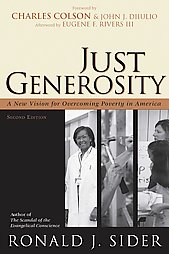
Just Generosity

In the weeks to come, I'll be blogging my way through this book Just Generosity, by Ronald Sider.

The back cover says: Ron Sider, author of the best-selling Rich Christians in an Age of Hunger, calls believers to care as much about the poor as Jesus did. He offers a new, holistic approach in which much expanded faith-based groups work with business, media, and government, uniting inner spiritual transformation and correction of structural injustice, to help end poverty in the world's richest nation.

June 09, 2007

Don't Always Give Your Best

Sometimes you should, sometimes you shouldn't. When? Why? Mason and i talked about that here. Below are some excerpts. But the original conversation is better.

Mason: I'm a coach. And sometimes what I see and experience makes me think, "Is it all about winning and losing? Is that the greatest purpose of what I do? Or of sports?" Maybe it's about giving your very best. If you believe that God created you, don't you think you owe it to Him to give your best? Even if you don't believe that, don't you at least owe it to yourself? I don't remember the times I won or lost so much as the times I gave it my all or just gave up...

David: ...there is almost always room for improvement, always something else you could do. How good is your best? With your track athletes for instance, at some point they quit working out and move onto other activities, other good activities. studies for instance.

I would liken it to propelling a vehicle. The best millage to speed ratio is 55mph. After that you can go faster, but it will cost you. And so it is with "giving your best" you can but it will cost you, often time, time that could be used on something better.

Mason: That's all fine Dave, but yours is a question of priorities. My comments are geared towards someone who has already made that decision, whether it be a workout or a competition. Once you have decided to use your time for that activity it only makes sense that you should give your very best. And your comment about not always striving for an A? That's weak. I'll quote a track & field legend. "To give anything less than your best is to sacrifice the gift" - Steve Prefontaine

David: Prefontaine's quote is representative of a broader American ideal, often called the protestant work ethic, which stems from a theology that everything, including work, should be done to the glory of God. (John Calvin and others) On paper I agree with this, but I feel strongly about what happens when this good idea goes too far. Hence my concern over as you say, priorities.

I really believe, and I think you'll agree, that our priorities are pretty screwed up in this country. (i.e. workaholics/latch key kids) Part of that problem comes from an over-competitive nature, and a desire not to "sacrifice a gift" which on the good side has propelled this country beyond all others by some measurements, (economic) but at what cost? (spiritual/ethical)

At the end of the day I'm not saying your original post was wrong. All I'm saying is that you should not ALWAYS give your best.

June 03, 2007

Stranger Than Fiction

Ever wonder when the Christ child realized he was the Son of God? Ever wonder what it was like for him to realize he had to die? Ever wonder what the outcome of such a terrible thing would be? Watch Stranger Than Fiction.


(yes I got paid to say all of this...)


(...no not really, your way too gullible)

This post is an example of what happens when a theology geek goes looking for spiritual themes in all the wrong places. (which yes, are often the best places) This is a film that thematically speaking, depicts many aspects of the life of Christ well. For me personally, I walked away from it closer to Christ.

May 28, 2007

A Memorial Day for the Pacifist

As a former Airman in the U.S. Air Force, I just want to take the time to say thank you to all of the anti-war demonstrators and pacifists of both today and wars gone by. I mean this sincerely. Even in the most just of wars, voices of dissent are for me a welcome addition to our public discourse. In this country we value freedom, freedom to speak our mind and voice our dissent. So on this day that we remember our men and women in uniform who gave their lives, I want to remember those who's voices of dissent, have mitigated the loss of life.

I may yet be employed by the military-industrial complex, and I am not a pacifist. (though I wish I was) But I have a deep respect for those who are, or who believe that a particular war is unjust and are willing to do something about it. To them I say thank you.

May 27, 2007

Somebody up there, pray for us

Allan Creech, a very catholic protestant, has a post here about praying to saints. He does a great job explaining our differences and letting us see points of commonality.

Here are his definitions of how protestants and catholics look at death and heaven. I think they are very informative. Among other things he is basically saying, if you would ask your grandmother to pray for you before she dies, why not after she dies?

Protestants = (generally speaking) When someone dies, there is immediate judgement and "sentencing," reward and punishment. Boom! If you have faith in Jesus, you "go to heaven" and in that same swift trip you are glorified, fully and completely transformed (if there is any thought of transformation at all this is when it happens) into the perfect Image of Christ and are ushered into the fullness of the Presence of GOD, without measure, forever. There is also then a separation from the rest of the Body. Maybe it's better to put it like this, a graduation from the Church to something else, the heavenly choir perhaps. There is no more interaction with any of the Church on earth. It's either not allowed or is somehow ontologically impossible, I'm not sure. There's not really any one set theologically worked out argument for why this is. Perhaps there may seem to be the one - that the contrary is not explicitly laid out in Scripture, or is interpreted as not being so.

Catholics = people are still members of the Church when they die, still able to participate, are still being worked on as a matter of fact (but that's another issue altogether isn't it). Catholics believe someone who is "in heaven" is able to hear us and are also able to continue to pray for us to God for help in whatever situation. They believe that a person who is "over there" has, logically, a bigger perspective and greater knowledge, and can intercede perhaps better than someone here. OK. They are NOT called on to believe that such persons have the ability to send powerful help down out of themselves. We're talking about intercession here. It's the continuation of how the Body of Christ works here on earth - I need help, I ask Liz to pray for me because I'm not the complete Christ in myself, she does, this prayer interacts with the great economy of God's Life moving back and forth between the great divide and things happen, somehow. If it doesn't, then let's just all shut up and ke se-frikin-ra, things will just happen and whatever. So, there's that.

May 22, 2007

U2 - I Still Haven't Found What I'm Looking For

I really appreciate this music. I blogged about it in the past here, discussing the theological truth that it represents. However beyond that, it reflects my own deep seeded dissatisfaction with the status quo of all things evil. (Which are at some level most everything that humanity is involved in.)

There is inside of me a somewhat youthful desire to see things changed, and yet a gnawing feeling that they very well may not. In so many ways I haven't found what I'm looking for. Yet in some respects I have begun to. Jesus Christ is a part of that beginning, so is my wife Joey and my son Nicholas. Many of you friends also represent beginnings of what I am looking for. For all of this I am very thankful.

(for now this video will reside permanently at the bottom of this blog)

May 19, 2007

Jerry Falwell, child of God

In spite of being an evangelical Christian, I'm pretty much the opposite of Jerry Falwell. Having said that, I really really appreciate the story that one of my friends wrote for the La Crosse Tribune. It appears below.

Jerry Falwell, child of God
By Joe Orso

Besides their species, Mao Zedong, the 14th Dalai Lama, Hitler, Elie Wiesel, Mother Teresa, Martin Luther King Jr., George W. Bush, Bill Clinton, Eleanor Roosevelt, Black Elk and Jerry Falwell share little in common.

They all have lived on Earth and had the qualities that make humans human. But besides that, they grew up in different times and places and have made names of their lives in very different ways.

Some we see as good, some as bad, and some as good or bad depending on our perspective.

On Tuesday, after a life that mixed religion and politics, Jerry Falwell, the television evangelist, founder of the Moral Majority, crusader against taking prayer out of schools, against homosexuality and against all things liberal, founder of Liberty University, a husband and father who said AIDS is God’s punishment for homosexuality, died at age 73.

Whether Falwell’s life was helpful for humanity or not, it was certainly a life that divided. He was not a peacemaker, but a man who spoke and acted on principles that offended some and inspired others.

We can argue whether Falwell’s principles were virtuous, as we argue about ideas all the time. The more useful conversation, though, is whether Falwell, our fellow human, was a child of God.

I like that phrase, “child of God.” It makes me think about a Lutheran who once told me who she saw when she looked into the eyes of a Muslim recently returned from a pilgrimage to Mecca. It makes me think about the people a Christian saw when he traveled to India and looked into the eyes of those he’d always assumed were going to hell.

But it’s a challenging phrase. Pick your favorite evil president, or the person with a morality too wide or too narrow for your liking, and place that phrase as the descriptor: George and Bill, children of God? Saddam Hussein and Paris Hilton, children of God? Jerry Falwell, child of God?

And does the phrase actually mean something as flesh means something, or is it just a cliche to be tucked into calendars with clouds and angels? I mean, do you experience what’s said by the metaphor?

And can you look into the eyes of a person who does not see you as a child of God and see him as a child of God? Did Falwell?

This prayer, posted by a reader on Beliefnet.com, might help him and us with these questions:

“It is a comfort to know that Rev. Falwell has now met his creator face to face, and has at last been brought to perfection by that Love that goes beyond the limits of our humanity. May he rest in peace, and may we all know mercy.”